Battery Voltage Indicator
What You Will Learn
Section titled “What You Will Learn”- Scale a battery voltage so it stays within the ADC input range.
- Calculate the divider ratio, ADC source resistance and measurement formula.
- Convert an ADC sample to millivolts using a wider integer type.
- Distinguish a measured voltage from state-of-charge estimation or battery protection.
The reference is a protected two-cell lithium-ion pack. Its maximum charging voltage is 8.4 V. This demonstration only measures the pack while the Uno is powered from USB. It is not a charger, balancing circuit, undervoltage cutoff or safety monitor.
Select the Divider
Section titled “Select the Divider”The circuit uses 39 kOhm from battery positive to A0 and 12 kOhm from A0 to ground. At 8.4 V, the ADC input is:
V_A0 = 8.4 x 12 / (39 + 12) = 1.976 VR_source = 39 kOhm || 12 kOhm = 9.18 kOhmThe divider keeps A0 below AVCC and gives the ADC a source resistance near the ATmega328P’s recommended range. Keep the battery’s negative terminal connected to Uno GND. Never connect the battery directly to A0, the 5 V pin, or USB.
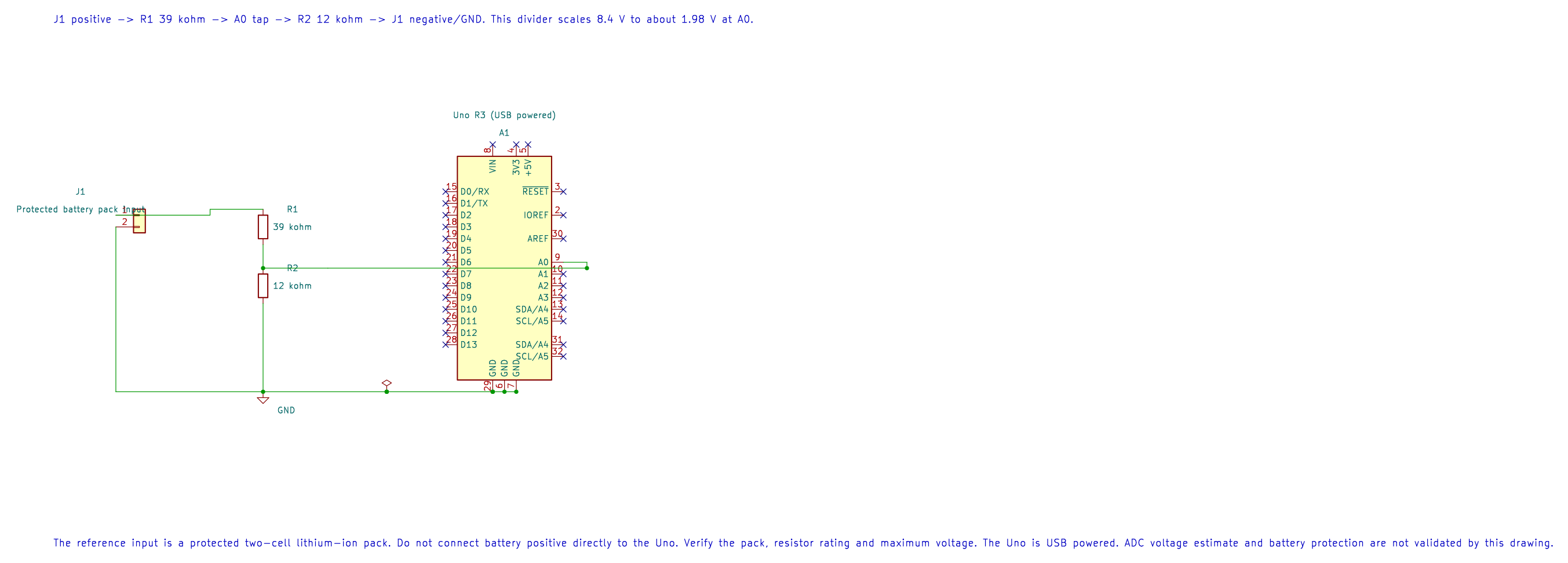
| Connection | Destination | Reason |
|---|---|---|
| Protected pack positive | 39 kOhm resistor, then A0 | Scales the pack voltage |
| A0 | 12 kOhm resistor, then pack negative | Divider return |
| Pack negative | Uno GND | Shared voltage reference |
| Uno | USB power | Keeps the demo independent of the pack input |
Measure resistor values and supply reference if accuracy matters. Use resistors with adequate voltage and power ratings. This divider slowly draws current from the pack while connected.
Convert ADC Counts to Pack Voltage
Section titled “Convert ADC Counts to Pack Voltage”With a nominal 5.000 V AVCC reference and a 10-bit ADC, the code estimates:
V_pack_mV = ADC_code x 5000 x (39 + 12) / (1024 x 12)The code widens the sample before multiplication because AVR int is only 16 bits. It prints a voltage twice per second. AVCC is not a precision reference; USB voltage, regulator drop, resistor tolerance and ADC error all affect the result. Calibrate the reference and divider against a meter before using the number for decisions.
Build the program with either supported compiler:
python "atmega328p-labs/tools/build.py" 78-battery-indicator --compiler gccpython "atmega328p-labs/tools/build.py" 78-battery-indicator --compiler xc8Expected output is a decimal voltage reading with three fractional digits. The source is a measurement example, not a battery state-of-charge meter. Voltage changes with load, temperature, age and cell chemistry; do not infer a safe discharge limit from this exercise.
/** * @file main.c * @brief Measure a protected two-cell battery with an ADC divider. * @details Uno R3 at 16 MHz. A 39 kohm top resistor and 12 kohm bottom resistor scale an 8.4 V * maximum input to about 1.98 V at A0. Use a protected pack and a separately powered measurement * circuit; connect grounds. AVCC is treated as 5000 mV in this example and must be calibrated. * This reports voltage, not state of charge or a protective cutoff. Hardware has not been tested. * @copyright Copyright (c) 2026 Arnab Kumar Das. CC-BY-SA-3.0. */#include "avr_hal/adc.h"#include "avr_hal/uart.h"#include <util/delay.h>
/** * @brief Print a bounded decimal voltage reading. * @param[in] millivolts Measurement in millivolts, 0..65535. * @retval AVR_OK Digits and unit were queued. * @retval AVR_ERROR_TIMEOUT A prefix may have been sent. * @details Prints integer volts with three fractional digits. Foreground only after UART setup. */static avr_status_t print_millivolts(uint16_t millivolts){    avr_status_t status = avr_uart_u16((uint16_t)(millivolts / 1000U));    if (status == AVR_OK)    {        status = avr_uart_put((uint8_t)'.', AVR_POLL_BUDGET);    }    if (status == AVR_OK)    {        uint16_t fraction = (uint16_t)(millivolts % 1000U);        status = avr_uart_put((uint8_t)('0' + (fraction / 100U)), AVR_POLL_BUDGET);        if (status == AVR_OK)        {            status = avr_uart_put((uint8_t)('0' + ((fraction / 10U) % 10U)), AVR_POLL_BUDGET);        }        if (status == AVR_OK)        {            status = avr_uart_put((uint8_t)('0' + (fraction % 10U)), AVR_POLL_BUDGET);        }    }    if (status == AVR_OK)    {        status = avr_uart_write((const uint8_t *)" V\r\n", 4U, AVR_POLL_BUDGET);    }    return status;}
/** * @brief Sample the divider and print the estimated pack voltage. * @return Does not return after successful peripheral setup. * @details Configures AVCC ADC reference, A0, and USART0 at 9600 8N1. Formula assumes 5000 mV * AVCC and the 39 kohm/12 kohm divider: code * 5000 * 51 / (1024 * 12). Use 32-bit intermediates. * Any setup or runtime timeout enters a terminal loop; no battery protection is implemented. */int main(void){    if ((avr_adc_init(AVR_ADC_AVCC) != AVR_OK) || (avr_uart_init(9600UL) != AVR_OK))    {        for (;;)        {        }    }    for (;;)    {        uint16_t sample = 0U;        avr_status_t status = avr_adc_read(0U, &sample, AVR_POLL_BUDGET);        uint32_t millivolts = ((uint32_t)sample * 5000UL * 51UL) / (1024UL * 12UL);        if ((status == AVR_OK) && (millivolts <= UINT16_MAX))        {            status = print_millivolts((uint16_t)millivolts);        }        if (status != AVR_OK)        {            for (;;)            {            }        }        _delay_ms(500);    }}
Code Walkthrough
Section titled “Code Walkthrough”Protected battery voltage indicator
Section titled “Protected battery voltage indicator”The example’s main() configures its peripherals, runs the algorithm and reports or displays the result. These source operations are listed in execution order:
if ((avr_adc_init(AVR_ADC_AVCC) != AVR_OK) || (avr_uart_init(9600UL) != AVR_OK))- This checks for any setup or transfer error before the program continues. Selects the reference in ADMUX and enables the ADC in ADCSRA with a divide-by-128 prescaler. At 16 MHz, the ADC clock is 125 kHz. The HAL keeps the result right-adjusted, waits for reference settling and leaves ADC interrupts disabled. Configures USART0 for asynchronous 8N1. It chooses a baud divisor and normal/double-speed mode, programs UBRR0/UCSR0A/UCSR0C, then enables receive and transmit in UCSR0B.for (;;)- Repeats the foreground task indefinitely; each pass checks inputs, advances the calculation or services the peripheral shown below.uint16_t sample = 0U;- Clears the state/counter after its threshold is reached so the next interval starts from zero.avr_status_t status = avr_adc_read(0U, &sample, AVR_POLL_BUDGET);- Selects the requested ADC channel in ADMUX, disables that pin’s digital buffer through DIDR0, discards the first conversion after a channel change, then polls with a finite budget and returns the 10-bit result.uint32_t millivolts = ((uint32_t)sample * 5000UL * 51UL) / (1024UL * 12UL);- Converts the integer ADC code into millivolts using the reference or divider ratio stated in the expression.if ((status == AVR_OK) && (millivolts <= UINT16_MAX))- Only enters the following block when the operation reports success.status = print_millivolts((uint16_t)millivolts);- Stores this intermediate or output value for the next algorithm step. Check the units and range represented by each operand.if (status != AVR_OK)- Tests the stated condition; the following block handles the matching case and the other path is skipped._delay_ms(500);- Waits for the stated interval; the foreground does no other work during this blocking delay.
Algorithm: The divider scales 8.4 V to about 1.976 V. Its 9.18 kohm Thevenin resistance stays near the ADC’s recommended source range; quantization and AVCC tolerance limit accuracy. Expected behaviour: For a protected 2-cell pack constrained to 0..8.4 V, the terminal reports a reading near the applied input twice per second. Quantization, AVCC and resistor tolerances affect the result HAL source files in this repository: ATmega328P HAL on GitHub
Common Problems
Section titled “Common Problems”- Reading is consistently high or low: Measure AVCC and the divider resistors; the example assumes 5.000 V and nominal resistor values.
- A0 reads zero: Check the divider return, pack negative and common ground.
- A0 voltage exceeds the reference: Disconnect the pack and recheck the divider values and maximum pack voltage before reconnecting.
- Readings jump: Check wiring, use short leads and average samples only after understanding ADC source settling and noise.
- Battery drains while idle: The resistor divider remains connected and consumes current even when the Uno is not sampling.
Try It Yourself
Section titled “Try It Yourself”If the real AVCC is 4.85 V but the conversion formula uses 5.00 V, which way will the calculated battery reading shift?
Answer: It will read high. The ADC code is based on 4.85 V, but the calculation multiplies it by 5.00 V.
References
Section titled “References”- Lab 78 source and wiring metadata
- ATmega328P documentation and datasheet, ADC electrical characteristics and conversion formula
- ADC concepts
- Electrical levels and safe loads