UART And Asynchronous Serial

Two Data Wires and a Shared Timing Agreement
Section titled “Two Data Wires and a Shared Timing Agreement”UART sends serial data without a separate clock wire. The transmitter and receiver agree on a baud rate and frame format. Connect TX to the other device’s RX and connect grounds. The logic voltage and baud-rate error must be acceptable to both devices.
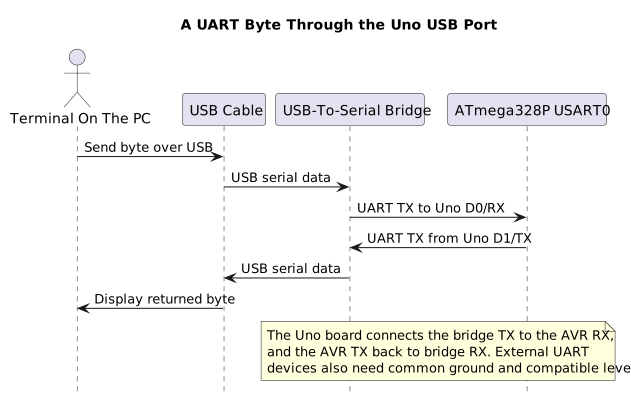
The Uno R3 exposes the ATmega328P USART on D0/RX and D1/TX. Its USB interface converts those UART signals to a computer COM port. A terminal setting such as 9600 baud, 8N1 means 9,600 symbol bits per second, eight data bits, no parity bit and one stop bit.
| Connection | Uno R3 Signal | Direction At The Uno |
|---|---|---|
| USB-to-serial bridge TX | D0 / RX | Into the ATmega328P |
| USB-to-serial bridge RX | D1 / TX | Out of the ATmega328P |
| Separate UART module TX | D0 / RX | Into the ATmega328P |
| Separate UART module RX | D1 / TX | Out of the ATmega328P |
| Separate UART module ground | GND | Shared reference |
For a separate module, cross TX and RX and confirm its logic levels before connecting it. The USB path already contains the board’s USB-to-serial bridge, so the COM4 echo test needs only the USB cable.
Calculate Frame Time
Section titled “Calculate Frame Time”An 8N1 frame has one start bit, eight data bits and one stop bit: ten bit periods total. At 9,600 baud, one frame takes approximately:
10 / 9,600 seconds ≈ 1.042 ms
This is why a foreground receiver that does lengthy work can overrun the hardware receive buffer. An interrupt-driven ring buffer can separate byte capture from slower application work, but it still has a finite capacity.
UART Is Not Rs-232
Section titled “UART Is Not Rs-232”The Uno UART pins use logic-level signals. Traditional RS-232 uses different voltage levels and polarity; connect through a suitable transceiver, not directly to D0/D1. Also check whether a module is 3.3 V-only before attaching it to a 5 V Uno.
The UART echo lab returns each received byte. Its COM4 test echoed 41 00 5A 7E at 9600 8N1 through the USB serial interface. That validates this byte path on the reference setup; it does not validate every UART module or cable.
The same example can be built with the course script. A build checks the firmware; the COM4 observation is the separate physical test:
python atmega328p-labs/tools/build.py 14-uart-echo --compiler xc8Exercise with Answer
Section titled “Exercise with Answer”Why might a terminal show each typed character twice?
Answer: The terminal may display local echo, and the board may also echo the received byte. Disable local echo when testing a firmware echo program.
Code Walkthrough
Section titled “Code Walkthrough”Example code on GitHub:
- USART Register-Level Echo (
71-usart-register-echo) - Interrupt-driven USART receive queue (
47-uart-buffer)
USART Register-Level Echo
Section titled “USART Register-Level Echo”The example’s main() configures its peripherals, runs the algorithm and reports or displays the result. These source operations are listed in execution order:
for (;;)- Repeats the foreground task indefinitely; each pass checks inputs, advances the calculation or services the peripheral shown below.if (usart_get(&received))- Tests the stated condition; the following block handles the matching case and the other path is skipped.
Algorithm: Configures UBRR0, UCSR0A/B/C and UDR0 directly; checks RXC0 and per-byte FE0/DOR0/UPE0 before echoing. Expected behaviour: Each error-free received byte is echoed once; malformed or timed-out receives are ignored HAL source files in this repository: ATmega328P HAL on GitHub
Bounded UART echo
Section titled “Bounded UART echo”The example’s main() configures its peripherals, runs the algorithm and reports or displays the result. These source operations are listed in execution order:
(void)avr_uart_init(9600UL);- Configures USART0 for asynchronous 8N1. It chooses a baud divisor and normal/double-speed mode, programs UBRR0/UCSR0A/UCSR0C, then enables receive and transmit in UCSR0B.for (;;)- Repeats the foreground task indefinitely; each pass checks inputs, advances the calculation or services the peripheral shown below.avr_status_t status = avr_uart_get(&byte, AVR_POLL_BUDGET);- Use the linked public header for this function’s parameters, register ownership, blocking behavior and status values.if (status == AVR_OK)- Only enters the following block when the operation reports success.(void)avr_uart_put(byte, AVR_POLL_BUDGET);- Waits for the USART transmit buffer within its poll budget, then writes the byte to UDR0.
Algorithm: One 8N1 frame contains ten bits. At 9600 baud, a frame takes approximately 1.042 ms; the application must service reception before hardware buffering overflows. Expected behaviour: Each received byte is echoed once HAL source files in this repository: ATmega328P HAL on GitHub
Interrupt-driven USART receive queue
Section titled “Interrupt-driven USART receive queue”The example’s main() configures its peripherals, runs the algorithm and reports or displays the result. These source operations are listed in execution order:
if ((avr_uart_init(9600UL) != AVR_OK) || (avr_uart_rx_start() != AVR_OK))- This checks for any setup or transfer error before the program continues. Configures USART0 for asynchronous 8N1. It chooses a baud divisor and normal/double-speed mode, programs UBRR0/UCSR0A/UCSR0C, then enables receive and transmit in UCSR0B. Enables the interrupt-driven USART receive queue. Start it after UART setup and enable global interrupts only when shared state is ready.return 1;- Stops this path and returns the indicated status when setup or validation cannot continue.(void)avr_gpio_mode(13U, AVR_GPIO_OUTPUT);- Maps the Uno header pin to its AVR port, sets its DDR direction bit and prepares the PORT latch for the requested initial level or pull-up.(void)avr_gpio_mode(8U, AVR_GPIO_OUTPUT);- Maps the Uno header pin to its AVR port, sets its DDR direction bit and prepares the PORT latch for the requested initial level or pull-up.avr_tick_init();- Configures the course millisecond tick interrupt source; it does not enable global interrupts itself.uint32_t previous = 0UL;- Clears the state/counter after its threshold is reached so the next interval starts from zero.sei();- Enables global interrupts after the example has configured its sources and shared state.for (;;)- Repeats the foreground task indefinitely; each pass checks inputs, advances the calculation or services the peripheral shown below.if (avr_uart_rx_get(&value) == AVR_OK)- The operation runs only after this API reports AVR_OK. Removes one byte from the receive queue without blocking; an empty queue returns a busy status.(void)avr_uart_put(value, AVR_POLL_BUDGET);- Waits for the USART transmit buffer within its poll budget, then writes the byte to UDR0.uint32_t now = avr_tick_ms();- Use the linked public header for this function’s parameters, register ownership, blocking behavior and status values.if (avr_elapsed(now, previous, 500UL))- Tests this condition to choose which algorithm path runs.previous = now;- Stores this intermediate value for the next step of the algorithm; check the operands and units.(void)avr_gpio_toggle(13U);- Atomically toggles the selected pin output latch.avr_uart_rx_stats_t stats;- Use the linked public header for this function’s parameters, register ownership, blocking behavior and status values.(void)avr_uart_rx_stats(&stats);- Use the linked public header for this function’s parameters, register ownership, blocking behavior and status values.if ((stats.dropped != 0U) || (stats.errors != 0U))- Tests the stated condition; the following block handles the matching case and the other path is skipped.(void)avr_gpio_write(8U, true);- Changes the pin’s PORT output latch; for an input pin this selects its pull-up state.
Algorithm: A finite single-producer/single-consumer queue separates the ISR from foreground processing; one slot distinguishes full from empty. Expected behaviour: Echo received bytes while LED L toggles; D8 latches high after receive loss HAL source files in this repository: ATmega328P HAL on GitHub
include/avr_hal/gpio.hinclude/avr_hal/tick.hinclude/avr_hal/uart.hinclude/avr_hal/uart_rx.hlib/interrupts/tick.clib/interrupts/uart_rx.csrc/gpio.csrc/uart.c