Using The TWI HAL
Configure the Bus
Section titled “Configure the Bus”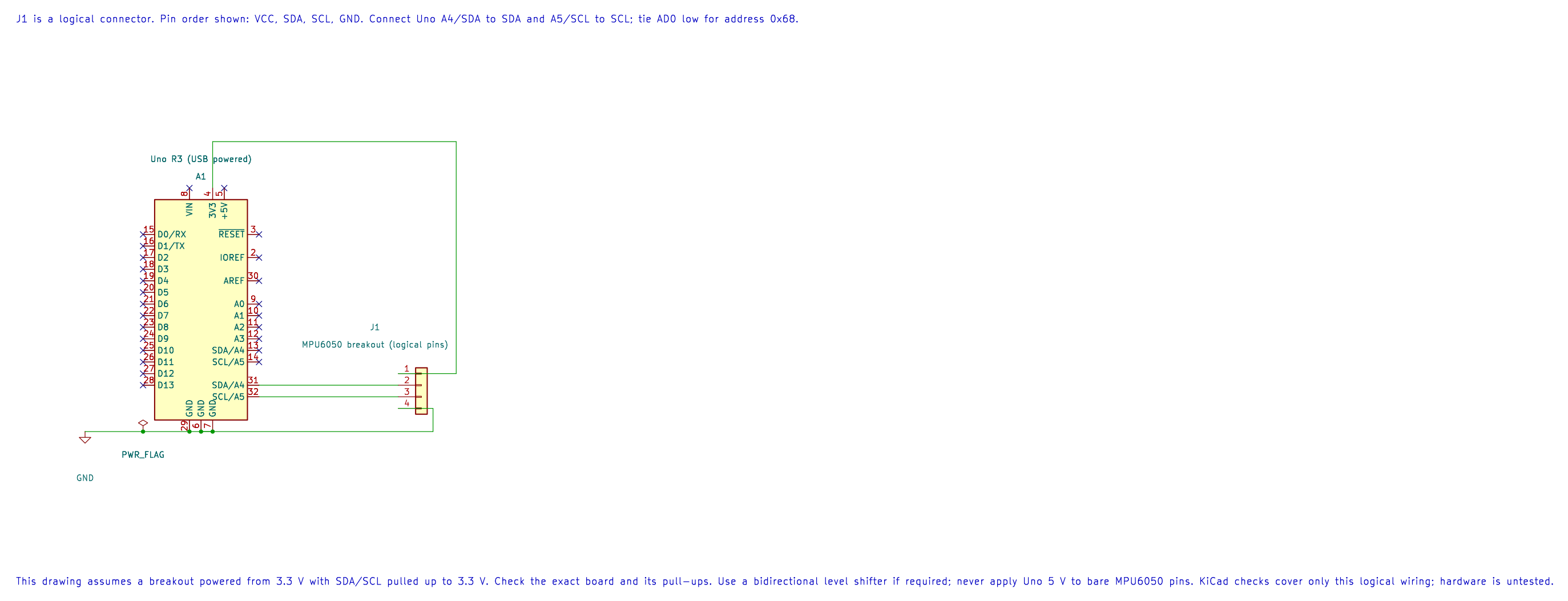
The interface is declared in avr_hal/twi.h and implemented in twi.c. avr_twi_init() accepts 100,000 or 400,000 Hz at the reference 16 MHz clock. It owns A4/SDA and A5/SCL, but the circuit must provide external pull-ups and voltage compatibility.
Transfer Contract
Section titled “Transfer Contract”avr_twi_transfer(address, tx, tx_length, rx, rx_length, budget) accepts an unshifted seven-bit address from 0x08 to 0x77. It writes the requested bytes and, when both directions are used, issues a repeated START before reading. The caller retains ownership of both buffers; the receive buffer may contain a partial result if the transaction fails.
The budget limits unsuccessful polls at each protocol state; it is not a whole-transaction time in milliseconds. The HAL distinguishes argument errors, NACK, arbitration loss, timeout and unexpected I/O state. It does not retry automatically. After arbitration loss it releases the bus without issuing STOP; after other errors it attempts STOP. If STOP times out, TWI is disabled. When a transaction error happened first, that original status is returned, so call avr_twi_init() after diagnosing the bus before trying again.
Use It with a Peripheral Data Sheet
Section titled “Use It with a Peripheral Data Sheet”Compare direct register access in Lab 74 with the HAL-based MPU6050 Lab 32. Lab 74 checks each START, address, data and final-NACK status explicitly. The HAL version keeps those state transitions in avr_twi_transfer() and reports a status to the caller. The TWI scan lab demonstrates an address probe. Do not interpret an ACK as a valid sensor measurement.
Build the scanner and HAL sensor consumer with the course script:
python atmega328p-labs/tools/build.py 22-twi-scan --compiler gccpython atmega328p-labs/tools/build.py 32-mpu6050 --compiler xc8Their builds have been validated; no physical TWI sensor test is recorded.
Exercise with Answer
Section titled “Exercise with Answer”Why is the receive buffer allowed to be partially filled on an error?
Answer: A transaction can fail after one or more bytes have already arrived. The API reports the failure and documents the partial buffer so the caller does not mistake incomplete data for a complete reading.
Code Walkthrough
Section titled “Code Walkthrough”Direct-Register TWI Identity Read
Section titled “Direct-Register TWI Identity Read”The example’s main() configures its peripherals, runs the algorithm and reports or displays the result. These source operations are listed in execution order:
uint8_t identity = 0U;- Clears the state/counter after its threshold is reached so the next interval starts from zero.DDRB |= _BV(DDB5);- Sets the Port B direction bits; a set bit selects output mode.PORTB &= (uint8_t)~_BV(PORTB5);- Sets or clears the Port B output latch. When the pin is an output, this determines its output level; on an input, it controls the pull-up.twi_result_t result = mpu6050_register_read(MPU6050_WHO_AM_I_REGISTER, &identity);- Stores this intermediate or output value for the next algorithm step. Check the units and range represented by each operand.if ((result == TWI_RESULT_OK) && (identity == MPU6050_WHO_AM_I_VALUE))- Tests the stated condition; the following block handles the matching case and the other path is skipped.PORTB |= _BV(PORTB5);- Sets or clears the Port B output latch. When the pin is an output, this determines its output level; on an input, it controls the pull-up.for (;;)- Repeats the foreground task indefinitely; each pass checks inputs, advances the calculation or services the peripheral shown below.
Algorithm: Directly controls TWBR/TWSR/TWCR/TWDR, checks each TWI status, uses repeated START, NACKs the final byte and bounds waits. Expected behaviour: D13 turns on when WHO_AM_I register 0x75 returns 0x68 HAL source files in this repository: ATmega328P HAL on GitHub
MPU6050 identity and acceleration
Section titled “MPU6050 identity and acceleration”The example’s main() configures its peripherals, runs the algorithm and reports or displays the result. These source operations are listed in execution order:
uint8_t identity = 0U, bytes[6];- Clears the state/counter after its threshold is reached so the next interval starts from zero.(void)avr_twi_init(100000UL);- Configures TWI for the requested bus rate and enables the peripheral. The bus still requires suitable external pull-ups and compatible signal voltage.(void)avr_uart_init(9600UL);- Configures USART0 for asynchronous 8N1. It chooses a baud divisor and normal/double-speed mode, programs UBRR0/UCSR0A/UCSR0C, then enables receive and transmit in UCSR0B.if (avr_device_read(0x68U, 0x75U, &identity, 1U) != AVR_OK || identity != 0x68U)- This checks for any setup or transfer error before the program continues. Selects a device register and reads the requested number of bytes using the driver’s TWI transaction.return 1;- Stops this path and returns the indicated status when setup or validation cannot continue.if (avr_device_write(0x68U, 0x6BU, 0U) != AVR_OK)- This checks for any setup or transfer error before the program continues. Writes the supplied bytes beginning at a device register using the driver’s bus transaction.for (;;)- Repeats the foreground task indefinitely; each pass checks inputs, advances the calculation or services the peripheral shown below.if (avr_device_read(0x68U, 0x3BU, bytes, 6U) == AVR_OK)- The operation runs only after this API reports AVR_OK. Selects a device register and reads the requested number of bytes using the driver’s TWI transaction.for (uint8_t i = 0U; i < 6U; i = (uint8_t)(i + 2U))- Repeats whilei < 6Uis true;uint8_t i = 0Usets the starting state andi = (uint8_tadvances it each pass.uint16_t raw = (uint16_t)((uint16_t)bytes[i] << 8U) | bytes[i + 1U];- Stores this intermediate or output value for the next algorithm step. Check the units and range represented by each operand.(void)avr_uart_u16(raw);- Formats an unsigned integer as decimal digits and sends them on USART0; it does not add a newline.(void)avr_uart_put(i == 4U ? '\n' : ',', AVR_POLL_BUDGET);- Waits for the USART transmit buffer within its poll budget, then writes the byte to UDR0._delay_ms(100);- Waits for the stated interval; the foreground does no other work during this blocking delay.
Algorithm: The default acceleration range is plus or minus 2 g with nominal 16384 LSB/g. Output is two’s-complement big-endian. The example prints unsigned bit patterns to avoid hidden signed conversion; values above 32767 represent negative readings. Expected behaviour: After identity verification and wake, six bytes are read as three raw 16-bit words HAL source files in this repository: ATmega328P HAL on GitHub
include/avr_hal/twi.hinclude/avr_hal/uart.hlib/drivers/register_device.clib/drivers/register_device.hsrc/twi.csrc/uart.c
TWI address probe
Section titled “TWI address probe”The example’s main() configures its peripherals, runs the algorithm and reports or displays the result. These source operations are listed in execution order:
(void)avr_twi_init(100000UL);- Configures TWI for the requested bus rate and enables the peripheral. The bus still requires suitable external pull-ups and compatible signal voltage.(void)avr_uart_init(9600UL);- Configures USART0 for asynchronous 8N1. It chooses a baud divisor and normal/double-speed mode, programs UBRR0/UCSR0A/UCSR0C, then enables receive and transmit in UCSR0B.for (;;)- Repeats the foreground task indefinitely; each pass checks inputs, advances the calculation or services the peripheral shown below.for (uint8_t address = 8U; address < 0x78U; ++address)- Repeats whileaddress < 0x78Uis true;uint8_t address = 8Usets the starting state and++addressadvances it each pass.if (avr_twi_transfer(address, NULL, 0U, NULL, 0U, AVR_POLL_BUDGET) == AVR_OK)- The operation runs only after this API reports AVR_OK. Performs a bounded TWI transaction at the requested 7-bit address; the result reports address/data phase errors.(void)avr_uart_u16(address);- Formats an unsigned integer as decimal digits and sends them on USART0; it does not add a newline.(void)avr_uart_put('\n', AVR_POLL_BUDGET);- Waits for the USART transmit buffer within its poll budget, then writes the byte to UDR0._delay_ms(1000);- Waits for the stated interval; the foreground does no other work during this blocking delay.
Algorithm: Address 0x68 is printed as decimal 104. Do not shift an address before passing it to this HAL. Probe only devices whose datasheets allow an empty write transaction. Expected behaviour: Responding 7-bit addresses print in decimal; an empty bus prints none HAL source files in this repository: ATmega328P HAL on GitHub
References
Section titled “References”- TWI HAL header and implementation
- TWI transaction programming The current HAL headers and implementation are documented in the HAL Library README and API comments.