10 kΩ NTC Thermistor
What You Will Learn
Section titled “What You Will Learn”An NTC thermistor’s resistance falls as its temperature rises. The Uno cannot measure resistance directly, so a fixed resistor and thermistor form a voltage divider. The ADC converts the divider voltage to a number; the firmware then estimates resistance and temperature.
Parts and Wiring
Section titled “Parts and Wiring”Lab 35 assumes a 10 kΩ NTC thermistor with a Beta value of 3950 K and a 10 kΩ fixed resistor. Check the exact part’s datasheet because thermistors with the same nominal resistance can have different Beta values.
| Connection | Destination | Purpose |
|---|---|---|
| Uno 5 V | 10 kΩ fixed resistor, then A0 | Divider high side |
| A0 | NTC lead 1 | ADC measurement node |
| NTC lead 2 | GND | Divider low side |
| Uno GND | Divider ground | Shared reference |
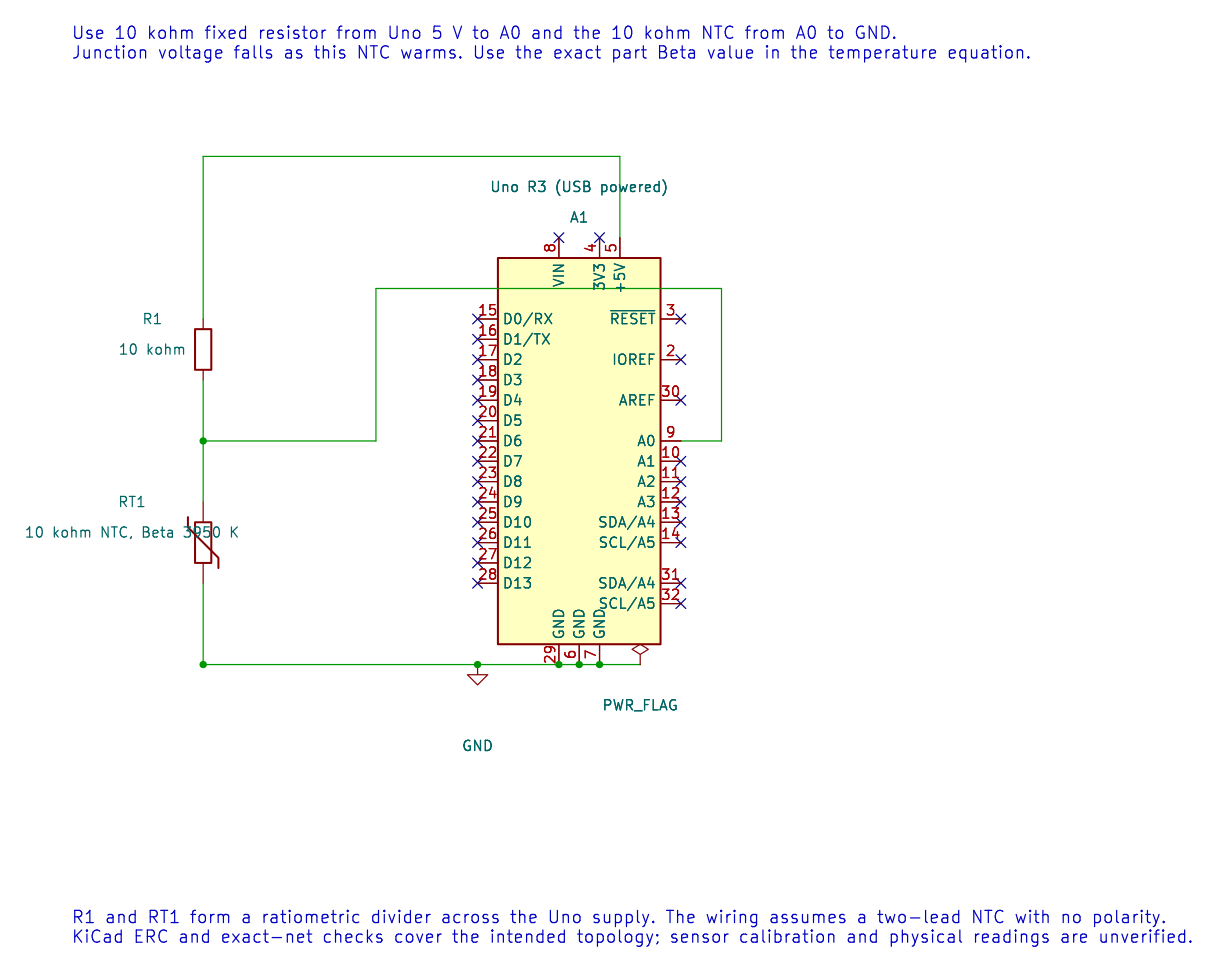
With this arrangement, warming the NTC lowers its resistance and usually lowers the A0 reading. Keep the sensor away from the Uno regulator and other heat sources.
Worked Resistance Calculation
Section titled “Worked Resistance Calculation”Let N be the 10-bit ADC result and let Rfixed be the resistor from 5 V to A0. For the wiring above:
Rntc = Rfixed × N / (1023 − N)If N = 512 and Rfixed = 10 kΩ, then Rntc ≈ 10 kΩ × 512 / 511 ≈ 10.02 kΩ. This is close to the nominal 10 kΩ point, which is normally specified at 25 °C.
The Beta equation estimates temperature in kelvin:
1/T = 1/T0 + ln(R/R0) / BLab 35 uses T0 = 298.15 K, R0 = 10 kΩ and B = 3950 K. Its serial output is hundredths of kelvin, so 29815 means 298.15 K. Subtract 273.15 to convert to Celsius: approximately 25 °C.
Firmware and Build
Section titled “Firmware and Build”The code rejects ADC values 0 and 1023 before dividing. Those rail readings indicate an open, shorted or out-of-range divider and do not provide a valid resistance. The example uses float and logf() to keep the Beta calculation readable; those functions increase Flash use. GCC and XC8 builds pass, but neither compiler result verifies a real sensor’s calibration.
python atmega328p-labs/tools/build.py 35-thermistor --compiler gccpython atmega328p-labs/tools/build.py 35-thermistor --compiler xc8Upload using the course serial workflow. Open a 9600-baud terminal and record the values at room temperature. Warm the sensor gently between your fingers and compare the direction of change with a separate thermometer. Do not use boiling water or expose the circuit to mains voltage.
Code Walkthrough
Section titled “Code Walkthrough”10k NTC divider
Section titled “10k NTC divider”The example’s main() configures its peripherals, runs the algorithm and reports or displays the result. These source operations are listed in execution order:
(void)avr_adc_init(AVR_ADC_AVCC);- Selects the reference in ADMUX and enables the ADC in ADCSRA with a divide-by-128 prescaler. At 16 MHz, the ADC clock is 125 kHz. The HAL keeps the result right-adjusted, waits for reference settling and leaves ADC interrupts disabled.(void)avr_uart_init(9600UL);- Configures USART0 for asynchronous 8N1. It chooses a baud divisor and normal/double-speed mode, programs UBRR0/UCSR0A/UCSR0C, then enables receive and transmit in UCSR0B.for (;;)- Repeats the foreground task indefinitely; each pass checks inputs, advances the calculation or services the peripheral shown below.if (avr_adc_read(0U, &sample, AVR_POLL_BUDGET) == AVR_OK && sample > 0U && sample < 1023U)- The body runs only when the conversion succeeds and its code is between 1 and 1022. The HAL selects the channel in ADMUX, disables the digital buffer through DIDR0, discards the first conversion after a channel change, and polls with a finite budget.float resistance = 10000.0f * (float)sample / (1023.0f - (float)sample);- Applies the divider equation for this wiring: R_NTC = R_fixed x ADC / (1023 - ADC), using the measured 10-bit ADC code.float kelvin = 1.0f / (1.0f / 298.15f + logf(resistance / 10000.0f) / 3950.0f);- Applies the Beta equation in kelvin using T0 = 298.15 K, R0 = 10 kohm and B = 3950 K. The constants must match the thermistor.uint16_t centikelvin = (uint16_t)(kelvin * 100.0f);- Multiplies kelvin by 100 so the integer output retains two decimal places without floating-point formatting.(void)avr_uart_u16(centikelvin);- Formats an unsigned integer as decimal digits and sends them on USART0; it does not add a newline.(void)avr_uart_put('\n', AVR_POLL_BUDGET);- Waits for the USART transmit buffer within its poll budget, then writes the byte to UDR0._delay_ms(500);- Waits for the stated interval; the foreground does no other work during this blocking delay.
Algorithm: The beta equation uses kelvin and a specified nominal resistance/beta. A different thermistor needs different constants. Floating-point logarithm is deliberately included to inspect its Flash cost. Expected behaviour: Prints approximate hundredths of kelvin; subtract 27315 to obtain hundredths of Celsius HAL source files in this repository: ATmega328P HAL on GitHub
Common Problems
Section titled “Common Problems”- The ADC is near zero or full scale: Check for a short, open connection, wrong divider order or missing ground.
- Temperature is plausible but offset: Verify the thermistor’s Beta value, nominal resistance, fixed-resistor tolerance and reference voltage.
- Values change slowly: The bead and its coating have thermal mass; allow time to settle and avoid touching it during a measurement.
- The calculation is too large for a product: Measure Flash and execution time, then consider a lookup table or fixed-point approximation.
Check Your Understanding
Section titled “Check Your Understanding”- If
Napproaches 1023 in this wiring, what does the equation predict and why should firmware reject it? - Why is a nominal 10 kΩ resistance not enough to identify the correct Beta constant?
- What does a serial value of
29315represent?
Suggested answers: The denominator approaches zero and the calculated resistance grows without bound; the reading indicates a rail/open condition and must be rejected. Beta varies by thermistor model even when nominal resistance matches. 293.15 K, which is 20 °C.
Source and Further Reading
Section titled “Source and Further Reading”- Lab 35 source
- Use the datasheet for the exact NTC part to obtain its R25, Beta value, tolerance and temperature range.
- ATmega328P Documentation, ADC section.