Read Constants From Flash Memory

Flash and SRAM Have Different Jobs
Section titled “Flash and SRAM Have Different Jobs”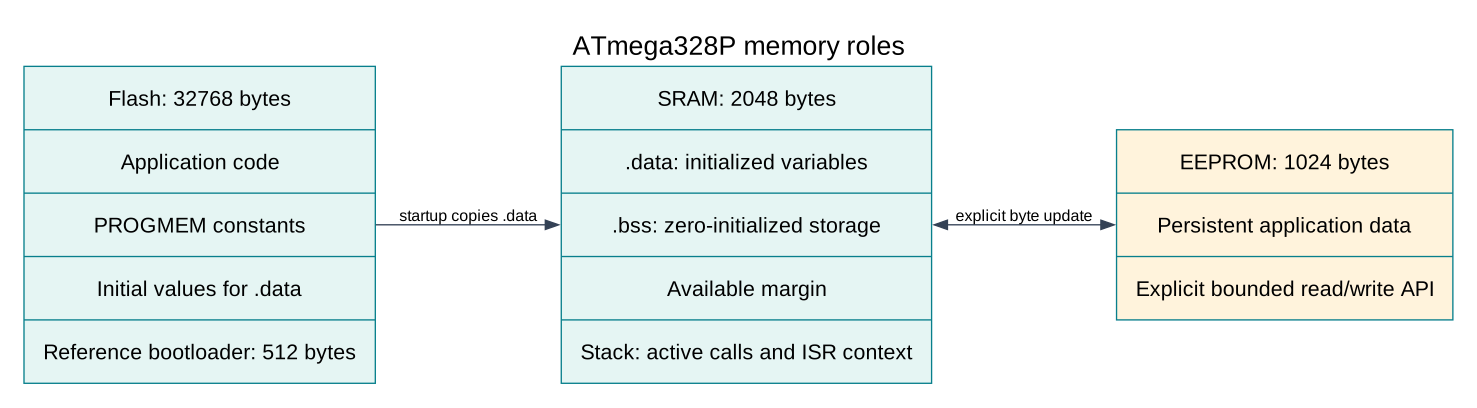
The ATmega328P stores instructions in Flash, while ordinary mutable C objects and the stack use SRAM. The Uno has 32 KB of Flash and 2 KB of SRAM. These memories have different address spaces and access rules on classic AVR devices.
const tells the compiler that code should not modify an object. On AVR, it does not by itself ensure that a large lookup table uses no SRAM. The course example marks its table with PROGMEM and reads each word with pgm_read_word(). That keeps the table in program memory and uses the device-specific access path.
The Flash constants lab stores the squares of zero through seven. The table needs 16 bytes because each value is a 16-bit word. Its result is small enough to print over USART and inspect in a serial terminal.
Check the Address Space and Type
Section titled “Check the Address Space and Type”When reading a table, use an index within its declared element count and use a read function matching the element width. For example, pgm_read_byte() reads one byte; pgm_read_word() reads a 16-bit value. Do not take a normal SRAM pointer to a PROGMEM object and dereference it as though it were a RAM array.
Compiler support varies across AVR toolchains. The examples use the selected AVR-GCC/XC8 AVR interfaces and are built with both toolchains. When moving the code to another compiler or MCU family, check that compiler’s program-memory annotations and read functions rather than copying macros blindly.
Reading Is Not Self-Programming
Section titled “Reading Is Not Self-Programming”This lesson only reads constants while the application runs. It does not erase or program Flash. Self-programming involves page erase/write operations and the bootloader section, reset vector, lock bits and fuse configuration. It is outside the beginner exercises.
The course Uno image reserves the top 512 bytes for its Optiboot bootloader, beginning at byte address 0x7E00. The course uploader rejects application data at or above that boundary and uses serial bootloader programming. Do not use a self-programming routine or a bootloader-burn operation to update an application. Preserve the installed bootloader and fuse settings.
Build and Inspect the Example
Section titled “Build and Inspect the Example”python "atmega328p-labs/tools/build.py" 25-flash-constants --compiler xc8Compare the Flash and SRAM totals in the build report. The build is evidence that both selected compilers accept the example; it does not prove the runtime table values on a physical board. The example does not write to program memory.
Exercises with Answers
Section titled “Exercises with Answers”- Why may normal pointer dereferencing fail for a
PROGMEMtable? Classic AVR separates program memory from ordinary SRAM access. Use the matching program-memory read operation. - Does
constalways mean zero SRAM use on an 8-bit AVR? No. Placement depends on the target and compiler. Use and verify the target’s program-memory mechanism. - Does the table-reading lab exercise bootloader self-programming? No. It only reads constants. It preserves the installed Optiboot image and fuse settings.
Code Walkthrough
Section titled “Code Walkthrough”Read a lookup table from Flash
Section titled “Read a lookup table from Flash”The example’s main() configures its peripherals, runs the algorithm and reports or displays the result. These source operations are listed in execution order:
(void)avr_uart_init(9600UL);- Configures USART0 for asynchronous 8N1. It chooses a baud divisor and normal/double-speed mode, programs UBRR0/UCSR0A/UCSR0C, then enables receive and transmit in UCSR0B.for (uint8_t i = 0U; i < 8U; ++i)- Repeats whilei < 8Uis true;uint8_t i = 0Usets the starting state and++iadvances it each pass.uint16_t value = pgm_read_word(&squares[i]);- Reads the table entry with the AVR program-memory access function; ordinary data-space dereferencing is not used for this Flash table.(void)avr_uart_u16(value);- Formats an unsigned integer as decimal digits and sends them on USART0; it does not add a newline.(void)avr_uart_put('\n', AVR_POLL_BUDGET);- Waits for the USART transmit buffer within its poll budget, then writes the byte to UDR0.for (;;)- Repeats the foreground task indefinitely; each pass checks inputs, advances the calculation or services the peripheral shown below.
Algorithm: PROGMEM keeps the table in program memory; pgm_read_word uses the appropriate Flash access. A const qualifier alone does not describe the AVR storage/access mechanism in all toolchains. Expected behaviour: Prints the squares of 0..7 HAL source files in this repository: ATmega328P HAL on GitHub
References
Section titled “References”- Flash constants example.
- Memory architecture and build artifacts.
- Microchip, ATmega328P device documentation, Flash and bootloader sections.